Loading…
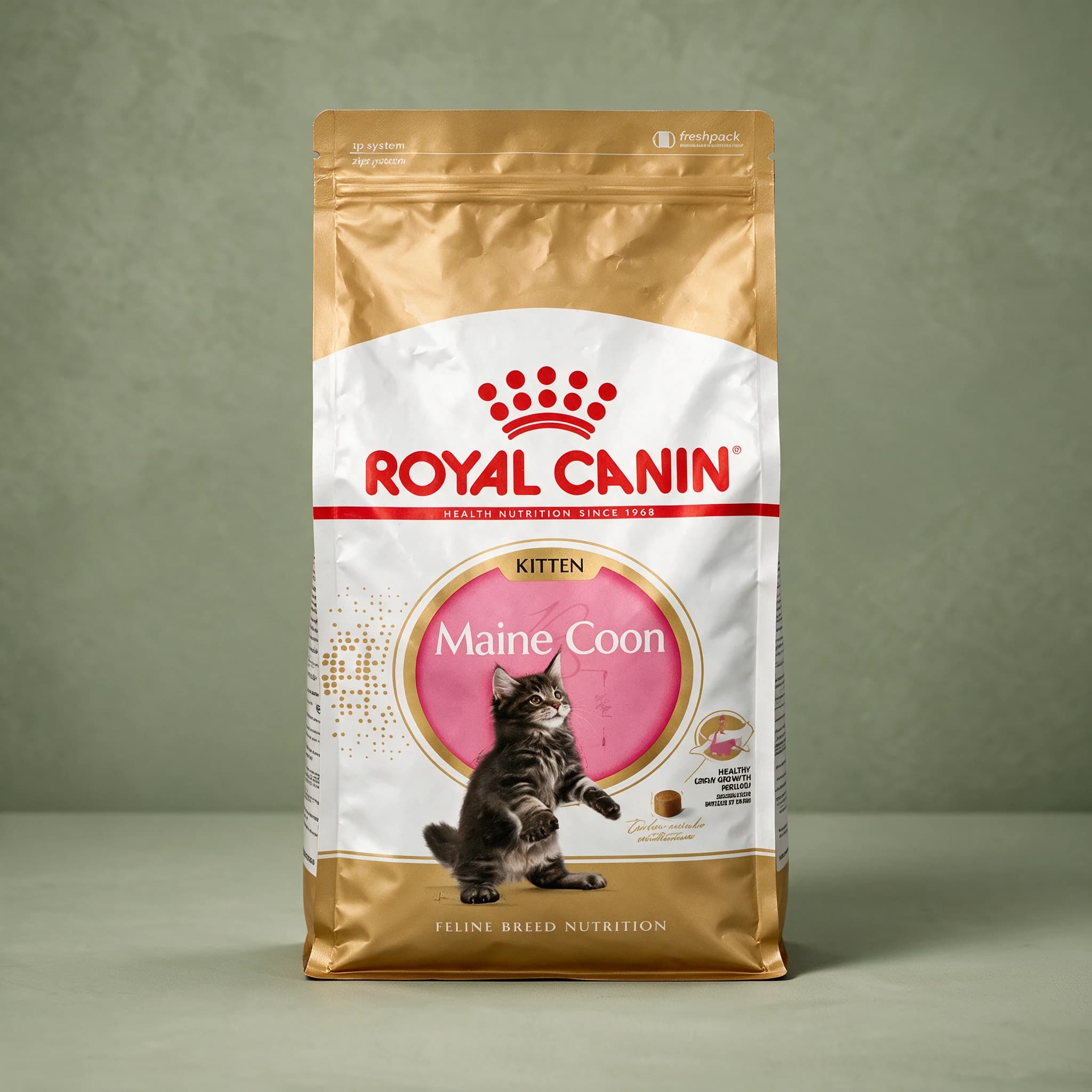
Fifteen months of growing. That's a long stretch to fuel.
Most kittens are done growing at twelve months. A Maine Coon is barely three-quarters of the way there — she'll keep building frame and muscle until around fifteen months, and sometimes longer. Feeding her on a standard kitten food means either running out of runway or switching to adult food too early.
This carries her through the whole stretch. Protein at 36% and fat at 23% support sustained growth in a cat that ends up substantially larger than average, with calcium at 1.32% and phosphorus at 1.15% set for skeletal development in a breed where the skeleton has a lot of work ahead of it. Glucosamine and chondroitin start supporting joints early, which matters for a cat predisposed to hip problems. DHA supports brain and vision development, and an antioxidant complex backs natural defences while her immune system is still finding its feet. The kibble is large and adapted to a jaw that's already broad.
Dehydrated poultry protein, animal fats, rice, vegetable protein isolate (L.I.P. — protein selected for its very high digestibility), maize, wheat flour, hydrolysed animal proteins, vegetable fibres, beet pulp, yeasts and parts thereof, fish oil, soya oil, fructo-oligo-saccharides, psyllium husks and seeds, minerals, hydrolysed yeast (source of manno-oligo-saccharides), yeast extracts (source of betaglucans), borage oil, marigold extract (source of lutein), hydrolysed crustaceans (source of glucosamine), hydrolysed cartilage (source of chondroitin). Additives (per kg) — Nutritional additives: Vitamin A 34,000 IU · Vitamin D3 900 IU · Vitamin E 690 mg · E1 (Iron) 31 mg · E2 (Iodine) 3.1 mg · E4 (Copper) 10 mg · E5 (Manganese) 41 mg · E6 (Zinc) 121 mg · E8 (Selenium) 0.06 mg. Technological additives: Clinoptilolite of sedimentary origin 10 g. Preservatives. Antioxidants.
Store in a cool, dry place, sealed. Use within six weeks of opening. Keep her on kitten food until fifteen months — moving her to adult food at twelve, as you would with any other breed, cuts the fuel while she's still building. Don't over-supplement or push growth; slow and steady is better for large-breed joints. Start brushing and nail-trimming early. Fresh water, always.
| Your dog weighs | Activity | Per day | A 4 kg bag lasts |
|---|---|---|---|
| 3–4 months | 1.5–3.6 kg — Dry only | 69 g | about 57 days |
| 3–4 months | 1.5–3.6 kg — Dry + ½ can Mother & Babycat | 45 g | about 88 days |
| 5–7 months | 2.6–4.8 kg — Dry only | 77 g | about 51 days |
| 5–7 months | 2.6–4.8 kg — Dry + 1 Kitten pouch | 56 g | about 71 days |
| 8–11 months | 3.4–6.3 kg — Dry only | 77 g | about 51 days |
| 8–11 months | 3.4–6.3 kg — Dry + 1 Kitten pouch | 56 g | about 71 days |
| 12–15 months | 4.2–7.6 kg — Dry only | 64 g | about 62 days |
| 12–15 months | 4.2–7.6 kg — Dry + 1 Kitten pouch | 43 g | about 93 days |
Keyed to age, with a weight range to read across. The table runs to fifteen months, which is when she moves onto the adult food. Split across three meals while she's small, then two. Fresh water, always.
No reviews yet — be the first to review Royal Canin Maine Coon Kitten Dry Cat Food.